 SageChimpSageChimp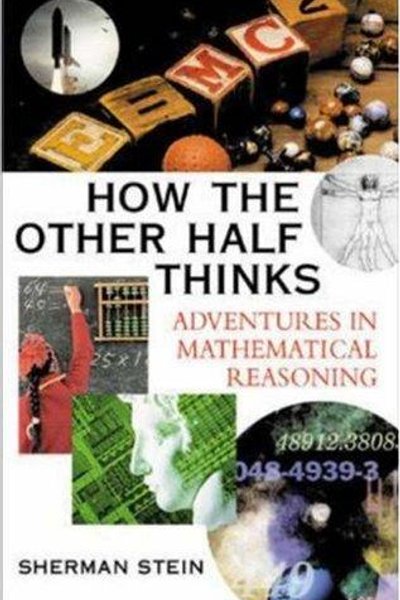
by Sherman K. Stein
'Some topics in advanced mathematics require nothing more than arithmetic and common sense. How the Other Half Thinks makes use of this phenomenon to offer both the mathematically adept and mathematical beginner eight fascinating illustrations of the mathematical way. Each chapter starts with a question about strings made up of nothing more than two letters. This question in turn suggests thought-provoking problems. After these problems are explored and solved, the author shows how the related mathematics has been applied in areas as varied as computers, cell phones, measurement of astronomical distances, and cell growth.An experienced educator, prize-winning expositor, and researcher, Stein engagingly presents each concept. The leisurely pace allows a reader to move slowly through each chapter, omitting no steps. This approach makes complex concepts like topology, set theory, and probability accessible and exciting. The book creates a bridge across the gulf between the two cultures: humanities and the sciences. Stein shows how the mathematical style of thinking is one that everyone can use to understand the world. This charming book speaks to both those who employ the intuitive, creative right half of the brain, and to those who rely more on the analytical, numerical left half. How the Other Half Thinks is for the novice and the skilled, the poet and the scientist, the left-brained and the right-brained. When you read this book, you are immersed in the world of mathematics, not as a spectator, but as an involved participant."Occasionally, in some difficult musical compositions there are beautiful, but easy parts"so simple a beginner could play them. So it is with mathematics as well. There are some discoveries in advanced mathematics that do not depend on specialized knowledge, not even on algebra, geometry, or trigonometry. Instead they may involve, at most, a little arithmetic, such as 'the sum of two odd numbers is even,' and common sense. As I wrote, I kept in mind two types of readers: those who enjoyed mathematics until they were turned off by an unpleasant episode, usually around fifth grade; and mathematics aficionados, who will find much that is new throughout the book.' Sherman Stein
SageChimp earns a small commission from purchases made through links on this page, at no extra cost to you.
No reviews yet. Be the first to review this book!