 SageChimpSageChimp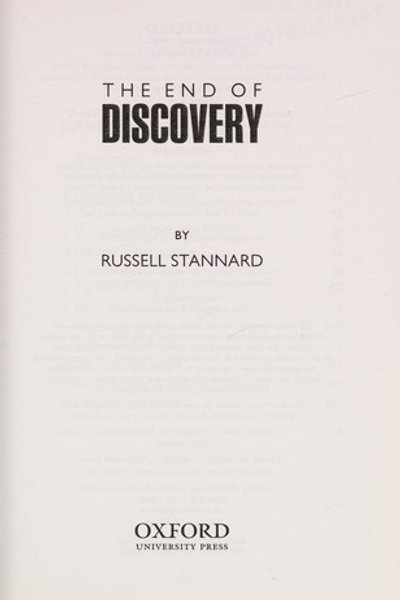
by Russell Stannard
"Many scientists make extravagant claims as to the scope and power of scientific thinking, claiming that ultimately it will provide a complete understanding of everything. But Russell Stannard, himself an eminent high-energy physicist, strongly disagrees with this grandiose claim. Indeed, in The End of Discovery, Stannard argues that eventually - perhaps in a few decades, perhaps in a few centuries - fundamental science will reach the limit of what it can explain. On that day, the scientific age, like the stone age and the iron age before it, will come to an end. To highlight the boundaries of scientific understanding, Stannard takes readers on an engaging tour of some of the deepest questions facing science today - questions to do with consciousness, free will, the nature of space, time, and matter, the existence of extraterrestrial life, and much more. For instance, from his own research field, he points out that to understand the subatomic world, scientists depend of particle accelerators, but to understand the very smallest units of nature, it has been calculated that we would need an accelerator the size of a galaxy. Clearly, unless a new approach comes along, we might never understand fully the most basic building blocks of the universe. As a scientist, Stannard remains hopeful that several of the questions addressed will one day be answered. But other puzzles will remain for all time - and we may never even realize it when we have hit an insuperable barrier in those directions. He assures us that there will always be new uses of scientific knowledge. Technology will continue. But fundamental science itself - the making of fresh discoveries as to how the world works - must ultimately grind to a halt."--Publisher's description.
SageChimp earns a small commission from purchases made through links on this page, at no extra cost to you.
No reviews yet. Be the first to review this book!